



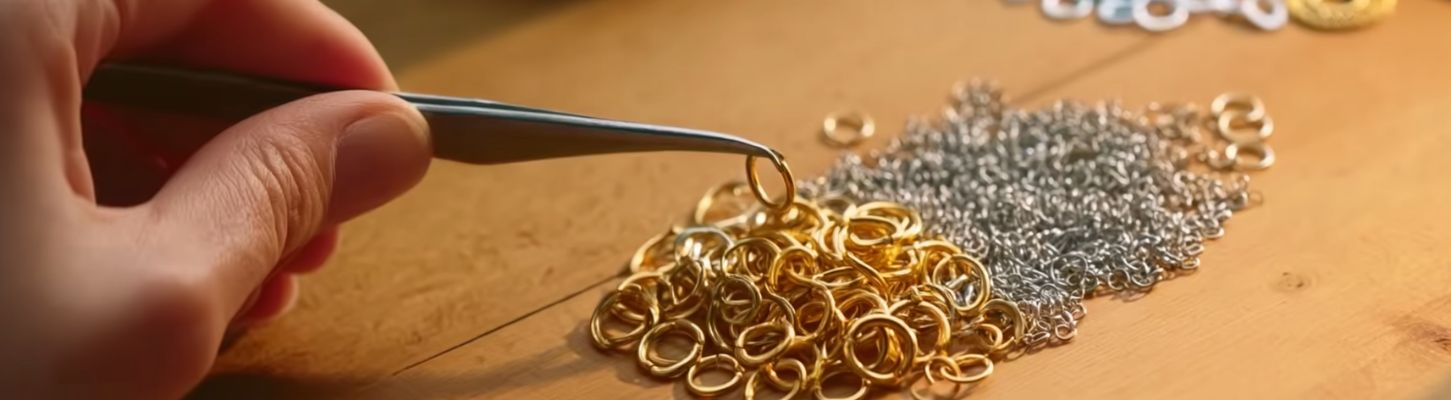
If you're getting into jewelry making, one of the first questions you'll run into is: what are jump rings actually used for, and why does nearly every project seem to need them?
Jump rings are the small metal loops that hold almost every piece of jewelry together. You use jump rings to attach clasps to chains, hang charms and pendants, link earring drops, join multi-part designs, repair broken pieces, and weave intricate chainmaille. Because they do this connecting work without any soldering or heat, you can link parts together in seconds with nothing more than a pair of pliers, which is exactly why they show up in almost every design you'll ever make.
In this guide, we'll walk you through exactly what jump rings do, the types and shapes that suit different projects, how to choose the right size, gauge, and metal, the correct technique for opening and closing them, common mistakes to avoid, and creative ways to put them to work. We're Atlanta Findings Company, and we supply these small but essential components to makers across the U.S. every day. So let's dive into the details.
Explore Our Categories


Table of contents
What Exactly Is A Jump Ring?
Think of it as a tiny circle of bent wire, a connector that does a lot of quiet heavy lifting in a finished piece. Most have a small break in the wire, and that opening lets you pry the ring apart and press it shut again with pliers. That simple gap is what makes it so useful. You can link parts together without any soldering, heat, or special skill.
Most jump rings are round, but you will also find oval and twisted shapes. They come in many sizes, wire thicknesses, and metals. Each of those choices affects how strong the connection is and how it looks in your finished piece.
Think of a jump ring as the handshake between two parts of your Jewelry. On a necklace, the loop is often the part that joins the chain to the clasp. Small as it is, it does a big job.
What Are Jump Rings Used For in Jewelry Making?
Their main job is connecting things, but jump rings do far more than that. A few everyday jobs come up again and again, and here's where jewelry makers reach for them most.
1. Attaching Clasps
This is the classic use. A jump ring links your clasp to the end of a chain or cord, so your necklace or bracelet can open and close. It is a clean, secure connection you can make in seconds.
2. Adding Charms and Pendants
Need to attach a charm to a bracelet, or drop a pendant onto a chain? This is the part doing the connecting. A jump ring is how you do it. It lets the charm swing freely and makes it easy to add, swap, or remove pieces later. Browse our charms and connectors to see how this works in a real design.
3. Creating Dangle Earrings
In earrings, jump rings link beads, drops, and small charms to your earring wires. They give the design movement, so the pieces hang nicely and catch the light as you move.
4. Connecting Multi-Part Designs
When a piece has several sections, jump rings join them with clean, even links. They help you keep the spacing and symmetry right while connecting chains, beads, and focal pieces into one flowing design.
5. Repairing Jewelry
Jump rings are a quick fix for broken pieces. If a charm falls off or a clasp comes loose, often a single jump ring is all you need to put it back together. Many makers keep a small stash on hand just for repairs.
6. Chainmaille and Artistic Designs
In chainmaille, jump rings are not just connectors. They are the whole design. Makers weave hundreds of rings together into patterns like Byzantine or Japanese weaves to build bracelets, necklaces, and more. Here, the rings are the art.
Different Types of Jump Rings
Knowing the different types of jump rings helps you pick the right one for the job. Each type balances ease of use against strength in its own way.
|
Type |
Best For |
Strength |
Notes |
|
Open |
Every day connecting, charms, repairs |
Good |
The most common type opens and closes with pliers |
|
Closed (soldered) |
Hanging pendants, high-stress spots |
Very strong |
No gap, so it will not pull open |
|
Split |
Pieces that get heavy wear |
Strong |
Wraps around twice like a key ring |
|
Twisted / Oval |
Decorative links, chainmaille |
Good |
Adds texture and a designer look |
Open Jump Rings
Open rings are the ones with a noticeable seam in the metal, which is exactly what gives you room to work them open and closed. They are the go-to choice for most jewelry making because they are so easy to work with. You will reach for these most often. We carry the 10mm copper open jump ring in a convenient set of 50.
Closed Jump Rings
Closed rings, on the other hand, are fused completely. The seam is soldered over, leaving a continuous, unbroken loop. That makes them stronger and more secure, which is ideal when you are hanging a heavier pendant or building a spot that takes a lot of movement. Our 6mm and 7mm closed copper jump rings are popular for exactly this.
Split Rings
Split rings look like tiny key rings and wrap around themselves twice. They hold very securely and resist pulling open, though they take a little more patience to work with. They're worth knowing about when security matters most, though our own collection focuses on open, closed, and twisted styles.
Twisted and Oval Jump Rings
Twisted and twisted-oval rings add a decorative touch. The twisted texture catches the light, and the oval shape sits nicely in certain chain patterns. Our 4mm antiqued copper twisted rings are a favorite for makers who want a more finished, designer look, and we also carry them in twisted-oval shapes at 6x5mm and 8x6.5mm.
Jump Ring vs. Split Ring: What's the Difference?
A standard jump ring has a single gap and is quick to open and close. It is easy to work with and sits low-profile in your design. A split ring wraps around itself twice, like a key ring, so it holds more securely but takes more effort to use.
So which should you pick? Use a regular jump ring when you want speed and a clean look. Use a split ring when the piece will take heavy wear, and you need extra hold. For the majority of designs you'll make, a well-formed ring strikes a comfortable middle ground that's easy to adjust, yet dependable enough to hold.
Materials and Finishes
Whatever metal you settle on will shape two things at once: how the piece reads visually and how long it holds up. Across our wider findings range, you'll find a variety of metals, and here's how the common ones compare so you can match the rest of your design.
-
Copper: A warm, affordable choice with great character, ideal for boho and rustic styles, and the metal our jump rings are crafted from.
-
Sterling silver: A premium feel that pairs well with high-end pieces.
-
Gold and vermeil: A rich gold look for elegant designs.
-
Rose gold: A warm, soft tone that is popular for modern Jewelry.
-
Brass: A bright, golden tone that works well in fashion jewelry.
A quick tip from us: always match your jump rings to the rest of your findings. A copper ring on a silver chain stands out for the wrong reason. Keeping your metals consistent throughout a piece reads as polished and intentional.
How to Open and Close a Jump Ring
Using a jump ring the right way keeps it round and secure. The trick is to twist, not pull. Here is how we do it.
What you'll need: two pairs of flat-nose or chain-nose pliers, your jump ring, and the parts you want to connect.
To open the ring:
-
Hold each side of the gap with a pair of pliers.
-
Twist one hand toward you and the other away from you.
-
This opens the ring sideways while keeping its round shape.
To close the ring:
-
Slide on the parts you want to connect.
-
Twist the ends back together using the same motion in reverse.
-
Gently rock the ends past each other, and back so they meet flush. You may feel a small click.
Never pull the ring open sideways by spreading the gap wide. That bends it out of shape and weakens it. The twist method keeps your rings strong and easy to close cleanly.
How to Choose the Right Size and Gauge
Two numbers matter when picking a jump ring: the diameter (how wide it is) and the gauge (how thick the wire is).
Diameter:
- 3mm to 5mm: delicate pieces and small charms
-
6mm to 8mm: a versatile range for most designs
-
10mm and up: chunky Jewelry or joining multiple strands
Gauge (wire thickness):
-
20 to 22 gauge: thin and flexible, good for lightweight designs
-
18 gauge: the most popular all-around choice
-
14 to 16 gauge: thick and strong, used for chainmaille and heavy pieces
When in doubt, a 6mm ring in 18 gauge handles a wide range of projects. As your designs get heavier, step up the gauge for more hold.
Common Mistakes to Avoid
Even with something this simple, a few small habits make a big difference. Below are the mistakes beginners run into time after time.
-
Pulling the ring open sideways. Always twist instead. Pulling warps the shape.
-
Using thin rings for heavy pieces. A thin ring can work open under weight. Match the gauge to the load.
-
Leaving a gap at the closure. Even a tiny gap can let a charm slip out. Close it flush.
-
Mixing metals by accident. Match your rings to your other findings for a polished look.
-
Skipping the tug test. Give every finished connection a gentle pull to be sure it holds.
Creative Ways to Use Jump Rings
Once you are comfortable with the basics, jump rings open up a lot of design ideas:
-
Chainmaille bracelets: weave rings into rich, textured patterns.
-
Multi-charm necklaces: space several charms along a chain.
-
Layered looks: attach different chain lengths to one clasp for a stacked effect.
-
Earring drops: hang elements at staggered lengths for movement.
Where Can I Get Jump Rings?
You can find jump rings at most craft stores and online jewelry supply shops, but quality varies a lot. Low-cost rings can bend, tarnish, or loosen over time, which is frustrating when you have put real effort into a piece. It pays to start with rings you can trust.
At Atlanta Findings Company, our copper rings come in an assortment of diameters and profiles to fit whatever you're building. You will find open, closed, twisted, and twisted-oval styles, sold in convenient sets. And once your order passes $100, shipping is on us. Browse our full jump rings collection to find the right ring for your next project.
Final Thoughts
Jump rings may be small, but they hold your whole design together. From attaching clasps and hanging charms to building earrings, joining multi-part pieces, making repairs, and weaving chainmaille, these little loops do more work than almost any other finding in your kit. Once you understand the different types of jump rings, the right sizes and gauges, and the simple twist technique for opening and closing them, you can build pieces that look clean and stay secure for years.
The key is starting with quality rings in the right metal for your design. Get that part right, and everything you create rests on a strong foundation.
Ready to stock up? Take a look through our jump ring lineup and pick out what fits your next build.
Need more help understanding what jump rings are used for in jewelry making? Contact our expert support team at info@Atlantabeadcompany.com or call +1 888-234-1234. Visit our blog for more insights.
Frequently Asked Questions
What Do You Use Jump Rings for When Making Jewelry?
You use them to connect parts of a piece: attaching clasps, hanging charms and pendants, building dangle earrings, joining multi-part designs, repairing Jewelry, and weaving chainmaille.
What is a Jump Ring on a Necklace?
On a necklace, the jump ring is usually the small loop that connects the chain to the clasp. It lets the necklace open and close and keeps the parts joined.
How Big Are Jump Rings?
Most fall between 3mm and 12mm wide. Smaller rings suit delicate charms, while larger rings work for chunky designs or joining several strands.
Which Material is Best for Jump Rings?
The right metal really depends on the style you're going for and the budget you're working with. Copper, which is what our jump rings are made from, is an affordable choice with lots of character that suits boho and rustic styles. Across Jewelry making more broadly, sterling silver and vermeil suit high-end pieces. Always match the metal to your other findings.
Are Split Rings Better Than Jump Rings?
Not better, just different. Split rings hold more securely but take more effort to use. Standard jump rings are quicker to work with and sit lower in a design. Let the amount of daily wear the piece will see guide your pick.
How Do I Open and Close Jump Rings Without Breaking Them?
Use two pairs of pliers and twist the ends in opposite directions rather than pulling the gap apart. Reverse the twist to close, and make sure the ends meet flush.


