



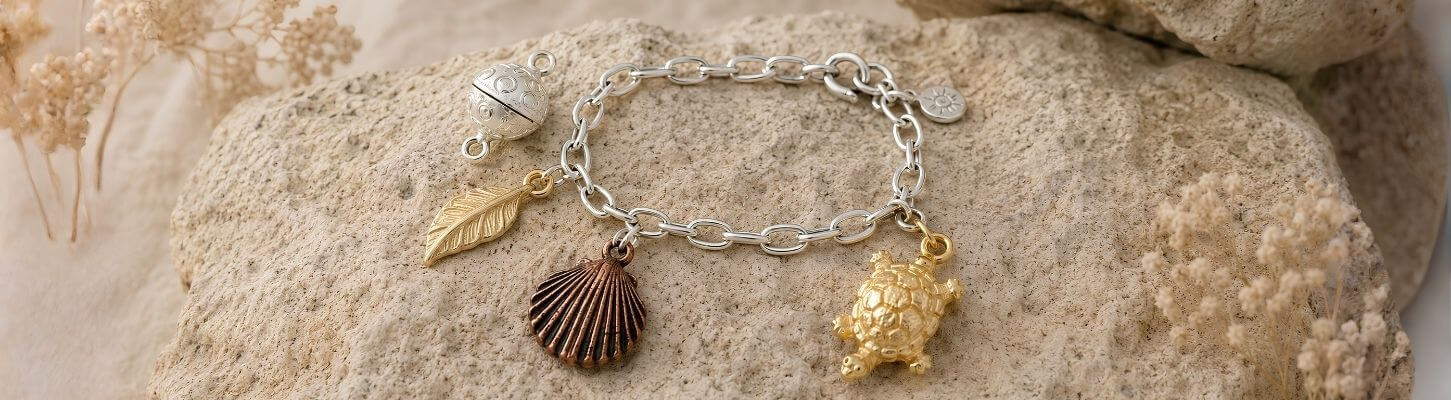
If you have ever spotted a delicate bracelet jingling softly with tiny pendants and wondered exactly what a charm bracelet is, you are looking at one of the most personal pieces of jewelry ever created. A charm bracelet is typically a wrist accessory, crafted from a chain or band, designed to hold small decorative pieces called charms. Each charm carries meaning for the wearer, whether it marks a milestone, honors a loved one, captures a memory, or simply represents a personal interest. Unlike most jewelry, which is finished the moment you buy it, a charm bracelet is designed to grow. You can add new charms over months, years, or even generations.
At Atlanta Findings Company, we work every day with the small but mighty pieces that make these bracelets possible: the charms, the jewelry connectors, and the clasps that hold every story together. In this guide, we will walk through what makes a charm bracelet so special, where the tradition started, what each popular charm represents, and how the bracelet itself is built.
Explore Our Categories



Table of contents
A Simple Definition: What Makes It a Charm Bracelet?
The clearest way to answer what a charm bracelet is is this: it is a piece of jewelry worn around the wrist that features attached ornaments, called charms, which hang freely or sit flat against the band. The charms are usually small, often metal, and almost always carry symbolic value.
Three things separate a charm bracelet from a standard bracelet:
-
The charm bracelet is structured around its charms, not its band. A simple link bracelet or a stretch cord becomes a charm bracelet only when charms are attached to it.
-
It evolves as charms are added over time. Most owners do not buy a complete charm bracelet at once. They start with a base bracelet and a few meaningful charms, then add more as life unfolds.
-
Each charm is personal. Two charm bracelets are almost never identical because no two life stories are identical.
This combination of customization, sentiment, and ongoing storytelling is why the charm bracelet has stayed popular across thousands of years and dozens of cultures.
The History of Charm Bracelets
The charm bracelet's history extends further back than many people realize. The idea of wearing small symbolic objects on the body traces back to prehistoric humans, who carved pendants from shells, animal bones, and clay and tied them to leather cords. Anthropologists believe these early charms were worn for protection from evil spirits or to invite good fortune, not for fashion.
Ancient Origins
Around 75,000 years ago in Africa, shells were strung together as personal adornments. Roughly 30,000 years ago in what is now Germany, people carved intricate charms from mammoth tusks. By the time of ancient Egypt, Mesopotamia, Babylon, and Rome, charms had become recognizable amulets used for protection, identity, and safe passage.
The Middle Ages
Charm bracelets continued during medieval times, when knights and noblewomen wore charms that signaled family heritage, religious belief, and political loyalty. These were among the first charms made of metal rather than bone or stone.
The Victorian Era: A Royal Spotlight
The modern charm bracelet really took shape in the 1800s. Queen Victoria of England wore charm bracelets featuring small portraits, lockets containing photographs, and personal mementos. As soon as the queen popularized them, charm bracelets spread quickly through European high society. Tiffany and Co., founded in 1837, helped cement the charm bracelet's status as a refined, upper-class accessory.
The 20th Century
Two major shifts happened in the 1900s. Soldiers returning from World War II often brought home small trinkets as keepsakes for sweethearts and family, which were attached to bracelets. Mass production also made charms affordable for everyone, not just royalty. By mid-century, the charm bracelet had become a milestone gift for graduations, sweet sixteens, weddings, and the birth of a child.
The Modern Era
Today, charm bracelets blend tradition with modern design. Sleeker chains, mixed-metal looks, themed collections, and modular Italian-style links share shelf space with the classic dangling charm. The reason they have endured is simple: people still want jewelry that means something, and few pieces tell a personal story as clearly as a charm bracelet.
What Does a Charm Mean in Jewelry?
Before we look at popular symbols, it helps to understand what the word "charm" actually refers to. In the context of jewelry, a charm refers to a small pendant attached to a chain, bracelet, or necklace, often with a jump ring. The word itself originally meant "song" or "incantation," which hints at the protective and almost magical purpose charms once held. Today, a charm is less about superstition and more about meaning, but the link to personal symbolism has never gone away.
What Each Charm Symbolizes: The Most Popular Meanings
The charm bracelet's meaning depends entirely on the charms a person chooses, and that is what makes the piece so individual. Listed below are some common symbols found on charm bracelets and their meanings.
Hearts stand for love, affection, family bonds, and close relationships. They are one of the most popular charms gifted between partners or by mothers to daughters.
Keys symbolize new beginnings, opportunity, and the unlocking of important life chapters. A key charm is often added when someone buys a first home, starts a new job, or graduates.
Stars and moons represent dreams, guidance, hope, and spirituality. Stars are tied to wishes and aspirations. Moons reflect change, intuition, and femininity.
Infinity symbols stand for eternal love, lasting friendship, and unbroken connection. Their popularity exploded in the 2000s, and they remain a go-to charm for couples and best friends.
Hamsa hands, originating from the Middle East and North Africa, are protective symbols. They are believed to ward off the evil eye and bring good fortune.
Evil eye charms serve a similar purpose. The blue eye charm is believed to protect the wearer by deflecting harmful energies and offering a shield of protection.
Horseshoes carry the meaning of luck and protection. The horseshoe must traditionally be worn pointing upward to "hold" the luck.
Four-leaf clovers represent rare good fortune. Each leaf stands for one of faith, hope, love, and luck.
Animal charms vary widely. Elephants symbolize wisdom, butterflies represent transformation, owls stand for knowledge, and turtles symbolize longevity.
Travel charms like airplanes, suitcases, globes, and miniature landmarks commemorate trips and adventures. They are popular with frequent travelers who add a charm after every meaningful journey.
Anchors are linked to stability, hope, and steadfastness. They are a favorite among people drawn to the sea or who view a relationship as their anchor.
Hobby and passion charms are deeply personal. A musician might add a guitar, a reader a tiny book, a photographer a camera charm.
When several of these are placed on a single bracelet, they form a wearable autobiography. No two collections are alike, which is precisely the point.
The Anatomy of a Charm Bracelet: What Goes Into Building One
Most articles stop at history and symbolism, but understanding the actual parts of a charm bracelet is what helps you choose, repair, or build one. A charm bracelet is made of four main components.
1. The Bracelet Base
This is the chain or band that goes around the wrist. It can be a cable chain, a curb chain, a paperclip chain, a snake chain, or a thicker bangle. The base needs enough surface area or open links to attach charms securely.
2. The Charms
These are the small ornaments that give the bracelet its personality. Charms come as flat blanks, dimensional shapes, themed sets, or single statement pieces. At Atlanta Findings Company, our charm sets and individual charms come in finishes including 22kt gold-plated copper, sterling silver, vermeil, antique, brass, and copper.
3. The Jump Rings
Jump rings are the small circular metal loops that attach a charm to the bracelet. There are two types. Open jump rings, which can be easily manipulated with jewelry pliers, are perfect for adding new charms to a bracelet. Closed (soldered) jump rings are permanent and used when the charm is meant to stay put. Without jump rings, most charms cannot connect to the bracelet at all.
4. The Clasp
The clasp closes the bracelet around the wrist. The most common types are the lobster claw clasp, the spring ring, the toggle clasp, the magnetic clasp, the box clasp, and the hook-and-eye clasp. The right clasp matters more than people think because it is what keeps every charm safe on your wrist all day.
An optional component in charm bracelets is the connector, which helps link various design elements. A pendant connector lets you layer multiple charms in one spot. A bar or multi-loop connector creates a clean transition between sections. Connectors are how designers turn a simple chain into a layered, custom-looking piece.
If you are sourcing components to build, repair, or design a charm bracelet, our charms and connectors collection brings these pieces together in one place, with finishes that mix and match across projects.
Types of Charm Bracelets
There is no singular style for charm bracelets. Several distinct types have emerged over the centuries, and each has its own audience.
The Traditional Dangle Charm Bracelet is the classic version most people picture. Charms hang loosely from a chain and move freely. Jingling sound and visible motion are part of the charm.
The Italian Charm Bracelet (Nomination Style) uses flat, rectangular modular links that sit flush against the wrist. Each link snaps onto a stretchy band, and the design is image-based rather than dangling. The style first gained attention in 1987 and saw its peak popularity in the early 2000s, becoming a widespread trend.
The Slider or Bead Charm Bracelet features charms shaped like beads with a hole through the middle, threaded onto a thicker cord or bangle. Modern slider bracelets popular today follow this style and let you mix beads, spacers, and themed charms.
The Bangle Charm Bracelet uses a rigid, often hinged metal cuff with small loops or stations where charms can be attached. The structure stays formal, while the charms add personality.
The Themed Charm Bracelet focuses on a single subject, such as travel, faith, motherhood, or a hobby. Every charm reinforces the theme.
The Photo Locket Charm Bracelet carries one or more small lockets that open to reveal photos of loved ones. This style traces directly back to Queen Victoria's bracelets.
Metals and Finishes for Charm Bracelets
The choice of metal influences the bracelet's appearance, durability, weight, and overall cost. Here are the most common options.
Sterling silver is bright, classic, and budget-friendly. It pairs well with almost any charm and resists tarnish reasonably well with care.
Yellow gold imparts a traditional and warm aesthetic, with solid gold serving as a long-term investment and gold-plated alternatives offering a similar look at a more affordable price.
Rose gold presents a soft, pink hue and a modern touch. It complements warm skin tones and works beautifully with floral or romantic charm themes.
White gold and platinum create a sleek, contemporary silver-toned appearance. While platinum is more durable and hypoallergenic, it tends to be more expensive.
Vermeil is sterling silver coated with a thick layer of gold. Gold-plated options provide the appearance of solid gold while being more affordable, offering an attractive alternative for those on a budget.
Antique and oxidized finishes give charms an heirloom feel. Antique brass, antique copper, and antique silver finishes are popular for vintage-inspired or bohemian designs.
Copper has an earthy, warm quality that suits handmade and rustic styles.
If you are designing a bracelet from scratch or sourcing parts in bulk, our component selection includes pieces in 22kt gold-plated copper, sterling silver, vermeil, antique, brass, and copper finishes, so you can match your charms, connectors, and clasps in a unified look.
How to Build a Charm Bracelet
Crafting a charm bracelet from individual components is simpler than many assume. Here is the basic process.
Start with the base. Choose a chain or bangle in the metal and length that suits your wrist (most bracelets sit around 7 to 8 inches).
Pick your clasp. Lobster claws and toggle clasps are the most common. Ensure the clasp size corresponds to the link size of the bracelet chain.
Choose your charms. Mix dimensional charms with flat ones for visual variety. Starting with three to five charms is a practical approach. You can always add more.
Attach the charms with jump rings. Open the jump ring sideways with two pairs of pliers (never pull it apart by spreading the gap), slip on the charm, slide it onto the bracelet link, and close the ring back to its original position.
Add connectors if you want layered or themed sections. A pendant connector can hold two or three small charms in one spot for a cluster look.
Test the finished piece. Put on the bracelet, walk around for a few minutes, and listen for any loose jump rings or sliding charms. Tighten as needed.
For makers and designers building in bulk, we offer wholesale pricing on charm sets, jewelry connectors, jump rings, and clasps. Visit our wholesale page for more information.
Why People Love Charm Bracelets
Charm bracelets have outlasted countless jewelry trends, and the reason is not aesthetic. It is emotional.
A charm bracelet is one of the only pieces of jewelry that grows alongside the person wearing it. A mother might give a daughter a bracelet on her sixteenth birthday with a single charm. The daughter adds a charm at graduation. Another at her wedding. Another at her first child's birth. Decades later, the bracelet is no longer a piece of jewelry. It is a wearable timeline.
Charm bracelets also work as the perfect gift because the giver does not have to guess the recipient's full taste. A single charm is a small, thoughtful, scalable gesture. When combined with a starter bracelet, the design allows the recipient to personalize it as they wish.
And in a market increasingly filled with mass-produced jewelry, the customization at the heart of the charm bracelet is more valuable than ever. Year after year, the popularity of personalized jewelry continues to grow, as more people seek unique, meaningful pieces. Charm bracelets sit at the very center of that trend.
How to Wear and Style a Charm Bracelet
Charm bracelets work both casually and formally. A few tips for styling.
Wear the charm bracelet on your dominant hand if you want it to be visible during conversation, or on your non-dominant hand if you prefer comfort and less interference with daily tasks. Tradition leans toward the left wrist, but there is no fixed rule.
Stack a charm bracelet with one or two simple bangles or a tennis-style chain bracelet to add dimension without overwhelming the charms.
Match the metal of your charm bracelet to your watch and rings for a cohesive look, or intentionally mix metals for a modern, eclectic feel.
Keep the charm count balanced. Five to nine charms usually photograph and wear best. Too many can crowd the bracelet and make individual symbols hard to see.
For dressier occasions, a charm bracelet with simpler charms reads as elegant. For everyday wear, mix textures, colors, and themed charms freely.
How to Care for a Charm Bracelet
Because charm bracelets have many moving parts, they need slightly more attention than a single-piece bracelet.
To keep the bracelet in good condition, take it off before engaging in activities such as showering, swimming, or using lotions and perfumes. Moisture and chemicals can dull plating and tarnish silver.
Store the bracelet flat in a soft pouch or dedicated compartment in a jewelry box. Avoid letting it tangle with other necklaces and bracelets, since the small charms can scratch each other or hook onto chains.
After each wear, wipe the bracelet gently with a soft cloth. For thorough cleaning, particularly for sterling silver, opt for a cloth specifically made for polishing silver to maintain its shine. For plated or antique finishes, avoid harsh polishes that can strip the finish.
Check jump rings every few months. Loose or slightly open jump rings are the most common reason charms get lost. Tighten them with two pairs of pliers, or replace them if the metal has weakened.
Sourcing Components for a Charm Bracelet
If you make jewelry, run a small studio, or simply want to build a charm bracelet rather than buy a finished one, the quality of your components matters as much as the design. Look for:
-
Charms with consistent finish and clean detail
-
Jump rings with even gauge and reliable strength
-
Connectors that fit smoothly onto the chain you are using
-
Clasps rated for the weight of charms you plan to add
-
Wholesale or bulk options if you are designing for resale
Atlanta Findings Company supplies charms, connectors, clasps, bead caps, and findings to designers, hobbyists, retailers, and studios across the United States. Our charms and connectors collection is a strong starting point for any charm bracelet project, and we offer wholesale pricing for larger orders.
Final Thoughts
A charm bracelet is more than jewelry. It is a small, wearable history of who someone is, what they value, and where they have been. From Egyptian amulets to Queen Victoria's lockets to a modern teenager's first sterling silver chain, the charm bracelet has stayed relevant because it is built around the one thing that never goes out of style: personal meaning.
At Atlanta Findings Company, we supply the charms, connectors, and clasps that bring those bracelets to life. Browse our charms and connectors collection to start building your next piece.
Want to know more about charm bracelets and the meaning, history, and symbols behind them? Pick up the phone and call us at +1 888-234-1234 or get in touch by email at info@atlantabeadcompany.com. Our team loves connecting with fellow jewelry makers and sharing what we know. Looking for more creative spark? Head over to our blog, where you'll find hands-on tips and plenty of inspiration to guide your next project.
Frequently Asked Questions
What is a Charm Bracelet, in Simple Terms?
A charm bracelet is a jewelry piece worn on the wrist, adorned with small, meaningful charms that are attached to the band. Each charm usually represents something personal, such as a memory, a milestone, a belief, or an interest. The bracelet is meant to be added to over time.
What Does a Charm Symbolize on a Bracelet?
Each charm carries individual significance. Hearts symbolize love, keys symbolize new beginnings, infinity symbols represent eternal connection, evil eye charms offer protection, horseshoes bring luck, and travel charms commemorate trips. The full meaning comes from the combination of charms the wearer chooses.
Which Wrist Do You Wear a Charm Bracelet on?
Traditionally, charm bracelets are worn on the left wrist, but there is no rule. Many people wear them on the non-dominant wrist for comfort, since charms can catch on clothing or interfere with writing and typing.
Are Charm Bracelets Still in Style?
Yes. Charm bracelets remain popular because personalization stays in demand year after year. Modern designs are sleeker than traditional dangle styles, but the concept of a wearable, customizable, sentimental piece has not gone out of fashion.
What is the Difference Between a Bracelet and a Charm Bracelet?
A regular bracelet is a finished design with a fixed look. A charm bracelet starts with a base chain or band and is built up over time by adding charms. The charm bracelet is meant to evolve, while a regular bracelet is meant to stay the same.
Can Men Wear Charm Bracelets?
Absolutely. Men have worn charm bracelets throughout history, especially in the medieval period and the 18th century. Modern men's charm bracelets often feature thicker chains, leather cords, and themed charms like anchors, compasses, or zodiac symbols.
How Many Charms Should a Charm Bracelet Have?
There is no fixed number, but most wearers find that five to nine charms look balanced. Fewer charms feel minimalist, while more charms create a fuller, jingling effect. The bracelet's chain length and weight capacity also play a role.
Can I add charms to any bracelet?
Almost any bracelet with open links, loops, or stations can become a charm bracelet. The easiest base is a cable, curb, or paperclip chain because the open links accept jump rings cleanly. Bangles need built-in attachment points unless you add them yourself.
How Do I Attach a Charm to a Bracelet?
Utilize a jump ring for charm attachment. Open the jump ring sideways with two pairs of pliers, slip the charm's loop onto it, then slide the jump ring onto the bracelet link, and close it back to its original shape. Never pull the jump ring open by stretching the gap apart, as it weakens the metal.
Are Charm Bracelets a Good Gift?
Charm bracelets are widely regarded as thoughtful and meaningful gifts in the realm of jewelry. You can start someone with a base bracelet and a single meaningful charm, knowing the recipient can add to it for years.


