



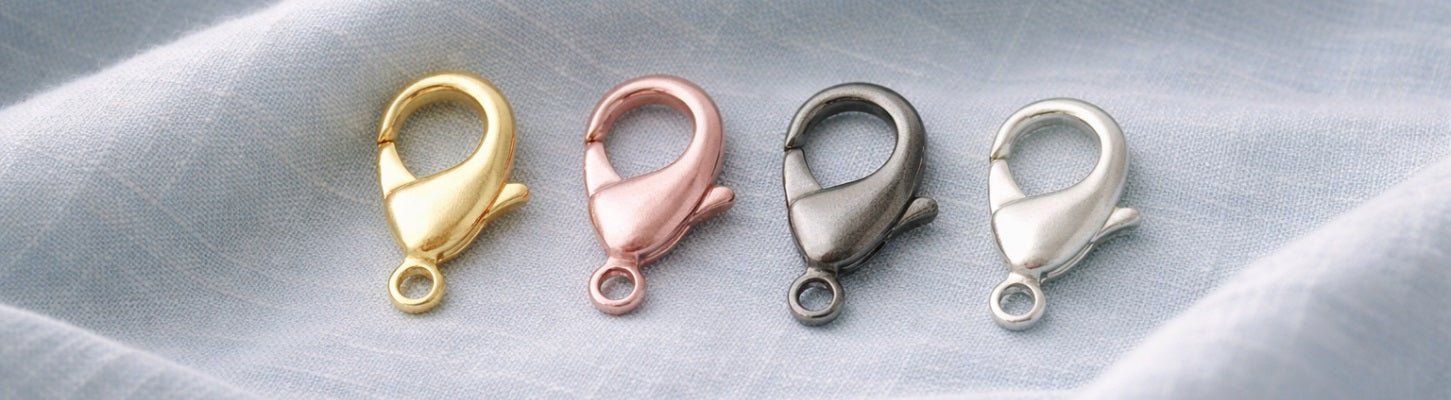
If you have ever picked up a bracelet, necklace, or even a keychain and noticed the small claw-shaped fastener on one end, you have already encountered a lobster clasp. Whether you are designing your first piece or sourcing findings in bulk, understanding what a lobster clasp is and how it works is essential knowledge for anyone in the jewelry industry. As one of the most widely used closures in jewelry making today, the lobster clasp earns its reputation through a combination of security, versatility, and ease of use. This guide from Atlanta Findings Company breaks down everything you need to know, from how the mechanism functions to which size to choose for your specific design.
Explore Our Categories


Table of contents
What Is a Lobster Clasp?
A lobster clasp is a spring-loaded fastener used to secure jewelry pieces such as necklaces, bracelets, and anklets. It gets its name from its visual resemblance to the claw of a lobster, featuring a pinching action created by a lever mechanism on one side of the body.
You may also hear it referred to by several other names, all of which describe the same finding:
- Lobster claw clasp (the most common alternate name)
- Trigger clasp (named for its trigger-like lever)
- Lobster hook
- Bocklebee clasp (less common, used in some trade contexts)
Regardless of what you call it, the mechanism is consistent: a small lever is pressed to open the clasp, the chain end or jump ring is inserted into the opening, and the lever is released so the spring snaps the clasp shut. This automatic closure is what sets the lobster clasp apart from toggle clasps or hook-and-eye clasps, both of which rely on tension or manual placement rather than a spring lock.
The lobster clasp became the dominant jewelry closure through the 20th century as mass production techniques allowed for consistent, affordable manufacturing. Today, it is found on everything from fine gold necklaces and sterling silver bracelets to fashion jewelry and everyday keychains.
What Is a Lobster Clasp on a Necklace?
If you are new to jewelry making or shopping for chain necklaces, you may be wondering specifically what a lobster clasp is on a necklace and how it differs from other closure options.
On a necklace, the lobster clasp is attached to one end of the chain and hooks into a jump ring or a small loop soldered to the opposite end. When you want to put the necklace on, you press the lever, slide the jump ring into the opening, and release the lever. The spring inside the clasp holds the ring firmly in place until you press the lever again to remove the piece.
For necklaces specifically, the lobster clasp offers a major practical advantage: adjustability. Many necklace designs pair a lobster clasp with an extension chain, which is a short length of chain with multiple links at the end. This allows the wearer to fasten the necklace at different lengths depending on the neckline they are wearing, without any additional hardware. This is a particularly popular configuration for choker-length chains and shorter pendants.
Necklace lobster clasps typically range from 9mm to 15mm in length. Delicate fine chains call for a smaller XS or small clasp so the finding does not visually overpower the piece, while heavier statement necklaces can accommodate a medium or large clasp without it looking out of proportion.
How Does a Lobster Clasp Work?
The mechanism inside a lobster clasp is simple but precise. Understanding it helps you choose higher-quality clasps, care for them properly, and explain their benefits to customers.
The Anatomy of the Action:
- The body of the clasp is an enclosed, rigid shell, typically oval or teardrop-shaped.
- Inside the body, a single-coil steel spring connects to the lever arm.
- When you press the lever (also called the trigger), it pushes against the spring and pulls back a small arm on the opposite side of the clasp opening, creating a gap.
- You slide the jump ring or chain link into that gap.
- When you release pressure on the lever, the spring forces the arm back into the closed position, locking the jump ring inside.
The key detail here is the steel spring. Unlike the body and lever, which are made from the same primary metal (sterling silver, gold-filled, brass, or stainless steel), the internal spring is always steel. This is intentional. Precious metals lack the tensile strength required to repeatedly compress and return to shape over thousands of open-close cycles. The Federal Trade Commission permits this steel spring inclusion in clasps while still allowing the piece to carry its primary metal designation, because the spring is a functional necessity, not a decorative component.
Parts of a Lobster Clasp
Every lobster clasp shares the same core components, regardless of size or style.
The Body
This is the main shell that gives the clasp its shape. It is usually oval, pear-shaped, or elongated, and is made from the primary jewelry metal.
The Lever (Trigger)
This is the small tab on the side of the body that you press to open the clasp. The size of this tab matters for usability. A larger, well-finished lever is significantly easier to operate, especially for customers with arthritis, long nails, or limited finger dexterity.
The Internal Spring
The coiled steel spring connects to the lever and creates the automatic return force that keeps the clasp closed at rest.
The Opening
This is the gap in the clasp body where a jump ring or chain link is inserted. The size of this opening determines what gauge of jump ring the clasp can accept.
The Fixed Ring or Loop
Most lobster clasps come with a small jump ring or soldered loop at the top of the body, which is used to attach the clasp to the chain or cord of the jewelry piece.
Types of Lobster Clasps
One of the reasons the lobster clasp is so dominant in the jewelry findings market is that it comes in a range of styles suited to different design aesthetics and functional needs. Atlanta Findings Company carries several of the most common lobster clasp variants.
Standard Oval Lobster Clasp
This is the classic style. The body is an oval or slightly flattened pear shape. It is proportional, low-profile, and works with the vast majority of necklace and bracelet designs. Available in virtually every metal finish and size range.
Elongated or Teardrop Lobster Clasp
This variant features a longer, narrower body than the standard oval. The elongated shape gives the clasp a slightly more elegant appearance and is often used on finer chain necklaces where a sleek profile is important. It is also easier to hold when fastening jewelry one-handed.
Swivel Lobster Clasp
A swivel lobster clasp includes a rotating joint between the body and the fixed ring at the top. This rotation prevents the chain from twisting and tangling during wear, making swivel clasps particularly useful for longer necklaces and heavier bracelets. They are a common choice for keychains as well.
Trigger Clasp (Large Format)
These are oversized lobster clasps designed for use on heavy chains, multi-strand pieces, or keychains where weight and pull force are higher. They operate on the same spring mechanism but are built with heavier gauge metal for greater strength.
Decorative or Shaped Lobster Clasps
Some lobster clasps feature decorative bodies, including heart-shaped, figure-eight, or floral designs. These clasps double as design elements, visible at the back of the neck or wrist rather than hidden away. They are popular in fashion jewelry and handcrafted artisan pieces.
Lobster Clasp Sizes: A Practical Guide
Choosing the right size is one of the most common questions jewelry makers ask when sourcing lobster clasps. The goal is to match the clasp visually and functionally to the weight and chain thickness of the piece.
Here is a general sizing guide based on common industry standards:
|
Size |
Approximate Dimensions |
Best For |
|
XS |
9mm x 5mm |
Delicate necklaces, thin chains, minimalist designs, permanent jewelry |
|
Small |
12mm x 5-7mm |
Standard necklaces, lightweight bracelets (most versatile) |
|
Medium |
15mm x 9mm |
Heavier chains, statement necklaces, chunky bracelets |
|
Large |
19-23mm |
Heavy-duty pieces, multi-strand designs, and men's jewelry |
|
XL / Trigger |
25-30mm+ |
Keychains, bag charms, industrial-use hardware |
Practical Tip for Size Selection:
A good rule of thumb is to choose a clasp that is roughly the same width as the chain links or cord you are working with. A clasp that is too large looks clunky on a delicate chain; one that is too small may not be strong enough to hold the weight of a heavier piece without the spring fatiguing prematurely.
For permanent jewelry applications, an XS lobster clasp is the industry standard. The small size allows for close placement near a welded link, and the lower weight minimizes the risk of the clasp pulling on the weld point.
Lobster Clasp Materials
The body, lever, and fixed ring of a lobster clasp are manufactured in a variety of metals to suit different budgets, applications, and customer preferences. The internal spring, as noted above, is always steel.
Sterling Silver (.925)
The most popular choice for fine jewelry findings. Sterling silver is hypoallergenic for most wearers, has a bright polish, and pairs beautifully with silver and white gold chains. It is susceptible to tarnish over time, but can be cleaned easily.
Gold-Filled
A cost-effective alternative to solid gold, gold-filled clasps feature a thick layer of gold bonded under heat and pressure to a base metal core. They are durable, tarnish-resistant, and a strong choice for customers who want gold aesthetics without solid gold pricing.
14K or 18K Solid Gold
Used in fine and luxury jewelry. Solid gold lobster clasps carry the same purity markings as the rest of a gold piece. Because the internal spring is steel, a solid gold clasp will still technically contain a small amount of steel by weight.
Brass with Plating
The workhorse of fashion and craft jewelry findings. Brass bases accept a wide range of electroplated finishes, including gold, silver, antique brass, antique copper, gunmetal, and rose gold. Quality matters here: solid brass-plated clasps hold their finish far longer than zinc alloy alternatives, which can crack and flake.
Stainless Steel
Increasingly popular for permanent jewelry, waterproof jewelry, and everyday wear designs. Stainless steel lobster clasps are highly resistant to tarnish, corrosion, and water exposure, making them ideal for clients who never remove their jewelry.
Lobster Clasp vs. Spring Ring Clasp
The lobster clasp's closest competitor in the findings market is the spring ring clasp. Both are spring-loaded, both are widely available, and both attach to jump rings or chain loops. But there are meaningful differences that affect which one you should use.
|
Feature |
Lobster Clasp |
Spring Ring Clasp |
|
Shape |
Oval/claw-shaped body |
Circular ring |
|
Lever size |
Larger, easier to press |
Small circular tab, harder to grip |
|
Security |
High (lever lock) |
Moderate (ring tension) |
|
Weight |
Heavier |
Lighter |
|
Cost |
Slightly higher |
Lower |
|
Ease of use |
Better, especially for bracelets |
More difficult one-handed |
|
Best for |
All jewelry types and weights |
Lightweight necklaces, delicate chains |
|
Adjustability |
Easy (extension chain compatible) |
Compatible but harder to operate |
The lobster clasp can generally be opened and closed with one hand, while the spring ring requires pinching a very small tab that many wearers find frustrating, particularly those with arthritis or limited dexterity.
For most everyday jewelry, especially bracelets and medium to heavy necklaces, the lobster clasp is the stronger choice. Spring rings earn their place on very lightweight chains and delicate pendants, where minimal visual weight at the clasp is the priority.
Lobster clasps are built from three parts: the spring, the trigger, and the body. The spring is always steel to maintain tensile strength, while the body and trigger are made from the primary jewelry metal.
Pros and Cons of Lobster Clasps
Like any jewelry finding, lobster clasps have real strengths and a few limitations worth knowing.
Advantages:
Lobster claw clasps are one of the most secure clasp options available. They do not rely on tension to stay closed but instead use an actual locking lever mechanism. They can usually withstand a significant tug without releasing, and different metals offer varying levels of strength depending on material quality.
- High security through a mechanical lock, not just tension
- Widely available in nearly every size, finish, and material
- Compatible with extension chains for adjustable-length designs
- Familiar to most wearers, reducing customer confusion
- Non-distracting design that keeps focus on the jewelry piece itself
- Works for necklaces, bracelets, anklets, and keychains
Limitations:
The main downside of lobster claw clasps is that some people find them difficult to use. A low-quality lobster claw might be stiff or have a broken internal spring that keeps the lever from working properly. Even a high-quality clasp that works smoothly can be challenging for people with arthritic hands or limited fine motor control.
- Can be bulky on very thin or delicate chains if oversized
- Slightly more expensive than spring ring clasps
- Difficult for some wearers with dexterity issues (especially small sizes)
- The internal spring is steel, which can be magnetic (relevant for lab testing)
How to Choose the Right Lobster Clasp for Your Design
With so many sizes, materials, and styles available, here is a practical decision framework for finding the right lobster clasp for each project.
Step 1: Assess the Weight of the Piece.
Heavier chains, multiple strands, and pendant necklaces with large stones all require a larger clasp with a stronger spring. Matching clasp size to piece weight ensures the spring does not fatigue prematurely.
Step 2: Consider Your Customer's Dexterity.
If you are designing for older customers or those with arthritis, choose a larger clasp with a substantial lever. A 12mm lobster clasp is the most versatile size and works for most necklaces and standard bracelets. It is the best seller for general-purpose jewelry making.
Step 3: Match the Metal Finish to the Rest of the Piece.
A gold-plated clasp on a silver-toned chain reads as mismatched to many buyers. Coordinate the clasp finish with the chain, wire, or cord throughout the design.
Step 4: Decide Whether Adjustability Matters.
If you want to offer adjustable length, source an extension chain in the same metal finish as your clasp. The lobster clasp hooks through successive links of the extension, giving the wearer a range of wearing lengths without any extra hardware.
Step 5: Consider the Application Beyond Jewelry.
Lobster clasps are also used for lanyards, badge holders, bag charms, and pet accessories. For non-jewelry applications, choose a larger size in a more durable material like stainless steel or heavy-gauge brass.
How to Attach a Lobster Clasp
Attaching a lobster clasp to a finished piece involves a few simple methods, depending on your material.
Using Jump Rings
The most common attachment method. Open a jump ring with two pairs of flat-nose pliers, thread it through the fixed ring at the top of the lobster clasp, and then thread it through the end link of your chain or the last bead loop of your design. Close the jump ring by returning it to its original position with the pliers. For added security, some makers use split rings instead of jump rings at the clasp attachment point.
Soldering
For a permanent connection, the clasp can be soldered directly to the chain. Use caution: the internal spring of any lobster clasp can lose its tension if exposed to heat above approximately 250 to 500 degrees Fahrenheit. Keep the torch flame away from the body of the clasp and solder at the chain connection point rather than on the clasp itself. If heat must be applied near the clasp, consider using heat-blocking paste or a heat sink clip.
Crimping
For strung bead designs using beading wire, a crimp tube or crimp bead can be used to secure the loop of wire through the clasp's fixed ring. Flatten or fold the crimp bead with crimping pliers to lock it in place.
Where Can I Buy a Lobster Clasp?
At Atlanta Findings Company, we stock lobster clasps in a range of finishes, including silver-plated, 22kt gold-plated, rose gold-plated, and black gold-plated, across sizes from 10mm through 23mm to suit everything from delicate chains to bold statement pieces. Whether you are finishing a single custom design or sourcing in bulk, our lobster clasp collection serves professional jewelers, craft jewelry makers, and retail buyers alike.
We invite you to browse our complete findings catalog or contact our team for guidance on selecting the best lobster clasp for your specific application.
Final Takeaway
Understanding what a lobster clasp is is essential for choosing the right one. The lobster clasp is one of the most reliable and versatile findings in the jewelry industry, and for good reason. Its spring-loaded lever mechanism provides security that tension-based clasps can't match, making it the perfect choice for both delicate jewelry and heavy statement pieces. Its availability in various sizes, metals, and styles allows it to adapt to virtually every design, ensuring your craftsmanship is both functional and elegant.
Whether you're a professional jeweler, an independent designer, or a craft maker, the lobster clasp should be in your toolkit. The right clasp protects your customer's jewelry investment, enhances the wearability of the finished piece, and reflects the overall quality of your work. Choosing the appropriate size, material, and style will ensure your creations last for years and don't end up at a repair bench.
If you have more questions about what a lobster clasp is, contact us at +1 888-234-1234 or via email at info@atlantabeadcompany.com. We're here to provide expert guidance. Visit our blog for answers and more!
Lobster Clasp FAQ
Can You Replace a Spring Ring Clasp With a Lobster Clasp?
Yes. This is one of the most common clasp upgrades customers request from jewelers. A jeweler will open the jump ring connecting the original spring ring to the chain and replace it with a lobster clasp of appropriate size. It typically takes just a few minutes and costs very little in parts.
Why Won't My Lobster Clasp Stay Closed?
A lobster clasp that does not stay closed usually has a fatigued or broken internal spring. This is more common in low-quality zinc alloy clasps than in solid brass or precious metal versions. The clasp will need to be replaced. High-quality clasps from reputable findings suppliers can last for many years with normal wear.
Is a Lobster Clasp Magnetic?
The body and lever are made from whatever primary metal the clasp is sold in (silver, gold, brass, stainless steel) and will not be magnetic. However, the internal steel spring will respond slightly to a magnet. This is normal and does not mean the clasp is not genuine precious metal. It is important to know when submitting pieces for laboratory assay testing.
What Size Lobster Clasp Should I Use for a Bracelet?
A small (12mm) or medium (15mm) lobster clasp works best for most bracelets. For chunky or wide cuff-style bracelets, a medium or large clasp provides both the strength and the visual balance the piece needs.
What is the Difference Between a Lobster Clasp and a Lobster Claw Clasp?
There is no functional difference. "Lobster clasp" and "lobster claw clasp" refer to the same finding. The terms are used interchangeably throughout the jewelry-making and supply industry.


